What Is a Gold IRA and How Does It Work?
A Gold IRA operates under IRS tax rules identical to a conventional IRA — the same contribution limits, deduction rules, and penalty structure — while holding physical precious metals instead of paper securities. Unlike standard IRAs that limit holdings to stocks, bonds, and mutual funds, a Gold IRA provides direct ownership of tangible assets with zero counterparty risk. Gold's inflation-hedging properties stem from its 0.15 correlation with the S&P 500 (World Gold Council, 2023): gold rose 35% in real terms during the 1970s stagflation and 166% from 2007 to 2012 during and after the financial crisis (London Bullion Market Association).
A Gold IRA company facilitates purchases of IRS-eligible bullion — such as American Gold Eagle coins (22-karat, 0.9167 fineness), Canadian Gold Maple Leaf coins (0.9999 fineness), and PAMP Suisse gold bars (0.9999 fineness) — then coordinates custodian reporting on IRS Form 5498, and directs physical storage to an approved facility such as the Delaware Depository or Brinks Global Services. A Gold IRA follows the same IRS contribution limits, rollover rules, and distribution schedules as a conventional IRA — making it a familiar tax wrapper around an unfamiliar asset class.
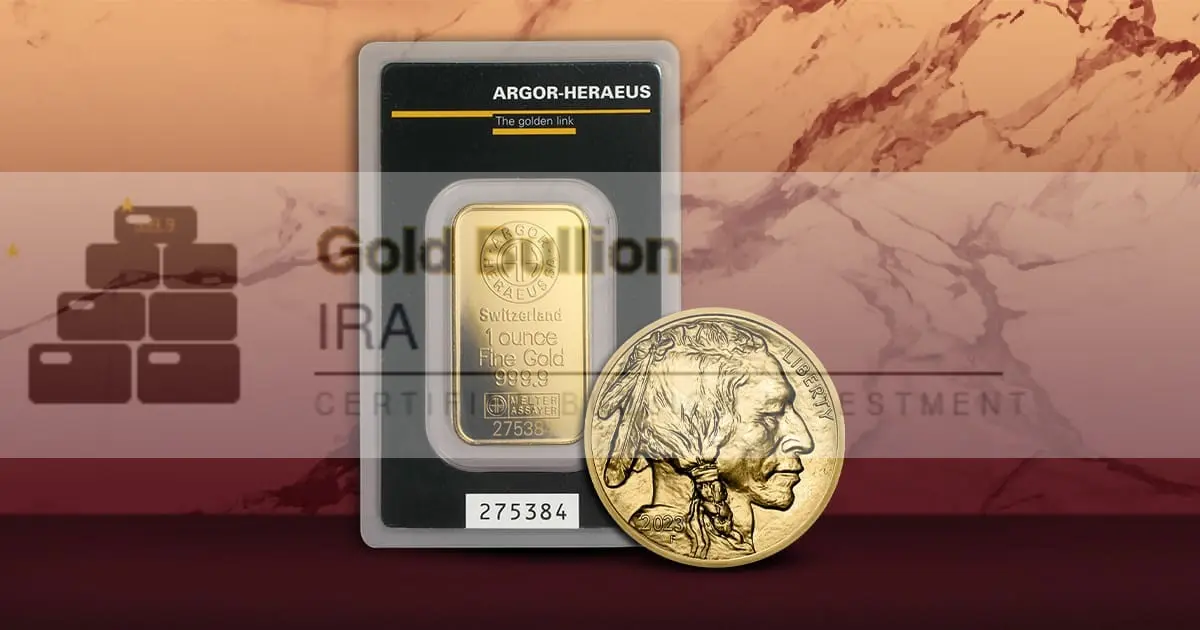
Self-Directed IRA Basics for Precious Metals
A self-directed IRA (SDIRA) is the vehicle that makes precious metals investing possible within a retirement account. Self-directed IRA custodians enable physical gold, real estate, and private equity — alternative assets that standard brokerage custodians explicitly prohibit from retirement accounts. The investor retains full control over asset selection while the custodian handles regulatory compliance, reporting, and record-keeping.
A Gold IRA walks investors through four structured steps — custodian selection, account paperwork, funding via rollover or contribution, and metal selection — typically completing setup within 1–2 business weeks.
Traditional, Roth, and SEP Gold IRAs
Gold IRAs come in three IRS-recognized structures — Traditional, Roth, and SEP — each requiring that physical gold meet a minimum fineness of .9950 (24-karat) to qualify for tax-advantaged treatment. A Traditional Gold IRA accepts pre-tax contributions, providing an immediate tax deduction with taxes due upon withdrawal in retirement. A Roth Gold IRA is funded with after-tax dollars, allowing for tax-free growth and qualified distributions. A SEP Gold IRA is designed for self-employed individuals and small business owners, offering higher contribution limits.
| Account Type |
2026 Annual Limit |
Age 50+ Catch-Up |
Tax on Contributions |
Tax on Withdrawals |
| Traditional Gold IRA |
$7,000 |
+$1,000 |
Pre-tax (deductible) |
Taxed as ordinary income |
| Roth Gold IRA |
$7,000 |
+$1,000 |
After-tax (non-deductible) |
Tax-free |
| SEP Gold IRA |
25% of net income |
None |
Pre-tax (deductible) |
Taxed; max $69,000 |
Source: IRS Publication 590-A (2025). All limits subject to annual IRS adjustment.
Compare Gold IRA Fees & Minimums
Ranked on 6 verified criteria — BBB rating, fee transparency, buyback terms, and 500+ third-party reviews. Data verified March 2026.
See Full Comparison →
Why Invest in Gold and Other Precious Metals?
Gold returned 9.1% annualized over 20 years (2004–2024) and outperformed the 60/40 portfolio in five of the last eight economic contractions (World Gold Council, 2024). As a non-correlated asset (0.15 correlation to the S&P 500), gold protected purchasing power through every major inflationary period since 1971. Central banks purchased 1,037 tonnes in 2023 and 1,045 tonnes in 2024 (World Gold Council) — the two highest annual totals since 1950 — signaling sovereign-level diversification out of USD reserves. Precious metals move independently of stocks and bonds, providing genuine portfolio diversification and systemic risk hedging when paper asset values decline.
For individual investors, the IRS permits up to 100% of a self-directed IRA in precious metals, though most financial advisors recommend a 5–15% allocation — enough to reduce overall portfolio volatility without sacrificing growth from equities. At that allocation, gold’s bid-ask spread (typically 0.5–2% from a reputable dealer) and annual storage fee ($100–$300) represent a manageable cost for genuine inflation protection and zero-counterparty-risk ownership.

Gold IRA Pros and Cons
A Gold IRA offers inflation hedging and tax-deferred growth, but carries higher fees and liquidity constraints than a standard IRA — here is how they compare side by side.
| ✓ Pros |
✗ Cons |
| Tax-deferred growth (Traditional) or tax-free distributions (Roth) on precious metals appreciation |
Higher annual fees than standard IRAs: $50–$300 custodian + $100–$300 storage |
| Zero counterparty risk — physical metal retains intrinsic value independent of any institution’s solvency |
Lower liquidity than stocks or ETFs — metal sales take 1–3 days through the custodian |
| Inflation hedge: gold rose 35% in real terms during 1970s stagflation and 166% from 2007–2012 |
No dividends, interest, or yield — returns depend entirely on price appreciation |
| Portfolio diversification through non-correlated asset class (0.15 correlation to S&P 500) |
Short-term price volatility: gold dropped 28% in 2013 and 10% in 2015 |
| Direct rollover from 401(k), 403(b), or IRA with no immediate tax consequences |
Dealer markups of 1–5% over spot price on every metal purchase |
| Tangible asset ownership — physical gold has maintained value for thousands of years across currencies |
RMDs at age 73 require metal liquidation or in-kind distribution — more complex than cash accounts |
Physical Gold vs Traditional Assets
Physical gold held in an IRA differs fundamentally from gold ETFs, mining stocks, or futures contracts. When you hold physical gold, you own a tangible asset that carries no counterparty risk. If a financial institution fails or a stock goes to zero, your physical gold retains intrinsic value regardless of institutional solvency — a fact that drove a 166% gold price surge between 2007 and 2012 while the S&P 500 fell 56% at its trough.
Traditional assets like stocks and bonds generate returns through dividends, interest, and capital appreciation, but they are subject to market cycles, corporate performance, and monetary policy decisions. Gold yields no income; gold derives price signals from global supply-demand dynamics — mine output (3,600 tonnes/year), central-bank buying, jewelry consumption, and ETF demand — making it a fundamentally different asset class that enhances portfolio resilience when combined with conventional holdings. The spot price (London Gold Fix, twice daily) and the bid-ask spread (typically 0.5–2%) determine your entry cost when purchasing bullion from a COMEX/NYMEX-approved refiner.
Approved Precious Metals: What You Can Hold
IRA-eligible metals must meet these exact fineness thresholds under IRC §408(m): gold .9950 (American Gold Eagles exempt at 0.9167), silver .999, platinum and palladium .9995 — produced by a NYMEX/COMEX-approved refiner or assayer, verified by an assay certificate. Everything else — Krugerrands, numismatics, proofs, collectibles — is prohibited and triggers immediate account disqualification if held.
The IRS qualifies only metals meeting fineness thresholds in §408(m) and stored in an IRS-approved third-party depository; home storage is a prohibited transaction regardless of the LLC or checkbook IRA structure used. Gold coins produced by a national government mint (American Eagle, Canadian Maple Leaf, Australian Kangaroo, Austrian Philharmonic) qualify automatically if they meet fineness. Bars qualify only if produced by a NYMEX- or COMEX-approved refiner with an accompanying assay certificate confirming weight and purity.
| Metal |
Min. Fineness |
IRS-Approved Products |
Prohibited |
| Gold |
.9950 (Eagles exempt) |
American Gold Eagle (22k, 0.9167), Canadian Gold Maple Leaf (.9999), Austrian Philharmonic (.9999), Australian Kangaroo (.9999), PAMP Suisse bars (.9999), Credit Suisse bars (.9999), Valcambi bars (.9999) |
South African Krugerrand, numismatic coins, proof coins, collectibles |
| Silver |
.999 |
American Silver Eagle (.999), Canadian Silver Maple Leaf (.9999), Austrian Silver Philharmonic (.999), Australian Silver Kookaburra (.999), PAMP Suisse silver bars (.999) |
Junk silver, pre-1986 coins, numismatics, below .999 fineness |
| Platinum |
.9995 |
American Platinum Eagle (.9995), Canadian Platinum Maple Leaf (.9995), Australian Platinum Koala (.9995), PAMP Suisse platinum bars (.9995) |
Below .9995 fineness |
| Palladium |
.9995 |
Canadian Palladium Maple Leaf (.9995), PAMP Suisse palladium bars (.9995), palladium bars from NYMEX/COMEX-approved refiners |
Below .9995 fineness |
Source: IRS §408(m)(3); IRC §408(m)(3)(A)(i). All products must be produced by a NYMEX- or COMEX-approved refiner, assayer, or manufacturer to qualify.

Gold, Silver, Platinum, and Palladium in an IRA
While gold is the most popular precious metal for IRA investors, silver, platinum, and palladium each offer unique benefits. Silver is more affordable per ounce and has significant industrial demand, particularly in electronics and solar energy. Platinum is rarer than gold and plays a critical role in the automotive and hydrogen fuel cell industries. Palladium has seen dramatic price increases driven by catalytic converter demand.
Many investors choose to diversify across multiple metals within their precious metals IRA. A common allocation might include 60-70% gold, 20-25% silver, and 5-15% split between platinum and palladium. Your Gold IRA company and financial advisor can help you determine the right mix based on your risk tolerance and retirement timeline.
Compare Top Gold IRA Companies
See how the leading providers stack up on fees, minimums, and customer service.
Request Free Information →
Storage, Security, and Depository Logistics
All IRA-held metals must be stored in an IRS-approved third-party depository; home storage is a prohibited transaction that triggers full taxation plus a 10% early-withdrawal penalty on the entire account. Approved depositories offer two storage models: allocated (segregated) storage, where specific bars and coins are assigned exclusively to your account, and unallocated (commingled) storage, where your metals are pooled with other clients' holdings of the same type. Allocated storage eliminates counterparty risk and is strongly recommended for IRA accounts.
Leading depositories include the Delaware Depository, Brink's Global Services, and International Depository Services. These facilities employ advanced security measures including 24/7 surveillance, biometric access controls, seismic sensors, and comprehensive insurance coverage. Most Gold IRA companies have established relationships with multiple depositories, giving you the flexibility to choose a facility and storage type that suits your preferences.

Taking Delivery Versus In-Account Storage
While your metals must remain in an approved depository as long as they are part of your IRA, you have the option of taking physical delivery when you reach retirement age or take a distribution. An in-kind distribution allows you to receive the actual metal rather than its cash equivalent. This can be advantageous if you want to personally hold your gold or believe the metal's value will continue to appreciate.
Taking delivery triggers a taxable event, and the distribution is valued at the metal's fair market value on the date of delivery. Early distributions before age 59 may also incur a 10% penalty. Many investors choose to keep their metals in the depository even after retirement, selling gradually as needed for income.
Costs, Fees, and Pricing Considerations
Expect $150–$300/year in storage fees, $50–$80 in annual custodian fees, and one-time setup costs of $50–$300 — plus a dealer markup of 1–5% over the spot price on every metal purchase. The spot price (London Gold Fix, set twice daily) is the baseline; the bid-ask spread and dealer premium are added on top. For a $50,000 account, a 3% dealer markup = $1,500 upfront cost before any annual fees. Compare dealer markups across companies before purchasing — reputable providers charge 1–3% over spot; markups above 5% are a red flag. Some companies also charge transaction fees for buying or selling metals, wire transfer fees, and account termination fees.
When comparing Gold IRA companies, look beyond the headline fees. Some providers waive the first year’s fees, offer fee reductions for larger account balances, or bundle services into a single annual charge. The most transparent companies publish their complete fee schedules on their websites and include all costs in their introductory materials. Be cautious of companies that are vague about pricing or pressure you to commit before disclosing all charges. For a 10-year holding period on a $50,000 account, total fee drag (storage + custodian) typically runs $1,500–$6,000 cumulative — factor this into your return expectations.
Know Before You Invest
Get a comprehensive Gold IRA guide with fee breakdowns, tax rules, and expert tips.
Download Free Guide →
Tax Advantages, Contribution Limits, and Withdrawals
Traditional Gold IRAs defer taxes until withdrawal; Roth Gold IRAs grow and distribute tax-free; both types trigger a 10% early-withdrawal penalty before age 59½ and require in-kind or cash distributions via the custodian. Your custodian files IRS Form 5498 to report contributions and Form 1099-R for distributions. At retirement, you may take an in-kind distribution of the physical metal rather than liquidating to cash — the distribution is valued at fair market value on the date of delivery.
Required minimum distributions (RMDs) begin at age 73 for Traditional Gold IRAs. Roth Gold IRAs have no RMDs during the account holder's lifetime. Early withdrawals before age 59 are subject to a 10% penalty plus applicable income taxes, with certain exceptions such as disability, first-time home purchase (up to $10,000), and substantially equal periodic payments (SEPP).
Required Minimum Distributions (RMDs) from a Gold IRA
Gold IRA holders reaching age 73 must begin taking Required Minimum Distributions (RMDs) — the same schedule that applies to Traditional IRAs. Taking an RMD from a physical metals account requires the custodian to either liquidate a portion of the metals (selling bullion to cover the RMD in cash) or execute an in-kind distribution (transferring physical metal directly to the account holder). In-kind distributions are taxed as ordinary income at the metal’s fair market value on the distribution date. Roth Gold IRAs have no RMD requirement during the owner’s lifetime.
RMD calculation example: Divide the prior December 31 account balance by the IRS Uniform Lifetime Table factor for your age. For a $250,000 Gold IRA at age 73 (factor: 25.7), the first RMD = approximately $9,709. Failure to take an RMD triggers a 25% excise tax on the shortfall (reduced to 10% if corrected within two years under SECURE Act 2.0). Your custodian reports RMD distributions on IRS Form 1099-R.
What Happens to a Gold IRA When You Die?
Under the SECURE Act 2.0 (effective 2024), most non-spousal beneficiaries must deplete an inherited Gold IRA within 10 years of the original owner’s death. Spouses may roll over the inherited account into their own IRA, continuing the original RMD schedule. Eligible designated beneficiaries — including minor children, disabled individuals, and those not more than 10 years younger than the deceased — may stretch distributions over their own life expectancy. The inherited account continues to hold physical metals at the depository until distributions are taken; each distribution is a taxable event at fair market value on the distribution date.
Rollovers, Transfers, and Existing IRA Funding
A Gold IRA rollover transfers funds from a 401(k), 403(b), or existing IRA without tax consequences if completed as a direct rollover (trustee-to-trustee transfer) — the safest method where funds move directly between custodians without touching your hands, with no withholding and no deadline. The alternative 60-day indirect rollover carries significant risk: your existing custodian withholds 20% for taxes, and you must deposit the full original amount (including the withheld 20% from personal funds) into the new IRA within 60 calendar days or face full taxation plus a 10% early-withdrawal penalty on the shortfall.
Critical: the once-per-year IRA rollover rule (IRC §408(d)(3)(B)) limits you to one indirect (60-day) rollover per 12-month period across all your IRAs combined. Violating this rule converts the second rollover into a taxable distribution. IRS Form 1099-R documents the distribution from the originating account; IRS Form 5498 documents the rollover contribution to your new Gold IRA. The 12-month clock runs from the date you receive the distribution, not the tax year.
Most Gold IRA companies specialize in facilitating direct rollovers from 401(k)s, 403(b)s, TSPs, traditional IRAs, 457(b)s, and other qualified retirement plans. The process is straightforward: your Gold IRA company coordinates with your existing plan administrator to move the funds directly, you select IRS-approved metals, and the purchase is executed within your new self-directed IRA. Disqualified persons (you, your spouse, lineal descendants, fiduciaries, and entities you control) may not contribute metals they personally own to an existing Gold IRA — this constitutes a prohibited transaction under IRC §4975.
How to Open a Gold IRA: Step-by-Step
Opening a Gold IRA is simpler than most people expect. The process typically takes one to two weeks from initial contact to having metals in your account. Begin by researching and selecting a reputable Gold IRA company, one with strong customer reviews, transparent pricing, A+ BBB ratings, and experienced precious metals specialists.
Once you have chosen a provider, you will complete an application to establish your self-directed IRA, designate your funding source (contribution, rollover, or transfer), select the precious metals you wish to purchase, and choose a depository for storage. Your Gold IRA company handles most of the paperwork and coordinates between the custodian, depository, and your existing retirement plan if applicable.
Choosing Metals and Allocations
Your metals selection should align with your investment goals, risk tolerance, and retirement timeline. Conservative investors often favor gold coins and bars for their stability and liquidity. Growth-oriented investors may allocate a larger portion to silver or platinum, which can offer higher upside potential but with greater price volatility.
Your Gold IRA specialist can provide current market analysis, historical price data, and allocation recommendations tailored to your situation. Many companies offer portfolio reviews and rebalancing services to ensure your precious metals allocation remains aligned with your overall retirement strategy as market conditions change.
Start Your Gold IRA Today
Join thousands of Americans who have protected their retirement with precious metals.
Open Your Account →
IRS Rules, Prohibited Transactions, and Penalties
The IRS prohibits certain transactions inside a Gold IRA under IRC §4975 — including personal use of metals, transactions with disqualified persons, and home storage — each triggering immediate account disqualification and full income tax on the entire balance. Disqualified persons include you, your spouse, your lineal descendants (and their spouses), fiduciaries, and entities you control. A checkbook IRA structure where an LLC holds the metals is a high-risk arrangement the IRS actively scrutinizes; multiple Tax Court rulings have disqualified such accounts. Any prohibited transaction immediately disqualifies the entire IRA, triggering full taxation plus a 10% early-withdrawal penalty if under age 59½.
Working with a reputable Gold IRA company and IRS-approved custodian is the best way to ensure full compliance. Your custodian files IRS Form 5498 annually to report account fair market value and IRS Form 1099-R for all distributions. IRS-approved non-bank self-directed IRA custodians include: Equity Trust Company (largest SDIRA custodian, $34B+ AUA), STRATA Trust Company, Kingdom Trust, Madison Trust Company, and Preferred Trust Company. Verify custodian registration directly with the IRS or your state banking regulator before opening an account.
Home Storage Gold IRA: Why It’s Illegal
Storing IRA-owned precious metals at home, in a personal safe, or in a safe deposit box you control is a prohibited transaction under IRC §408(m). Any home storage arrangement — even through a self-directed LLC checkbook IRA — is treated as a distribution of the full account value, triggering ordinary income tax plus a 10% early-withdrawal penalty if under age 59½. Companies that market “home storage Gold IRAs” expose investors to significant IRS penalties; the IRS has issued numerous private letter rulings against such structures. The only compliant storage is in an IRS-approved third-party depository such as the Delaware Depository or Brinks Global Services.
Is a Gold IRA a Good Idea? Addressing the Ramsey Critique
Dave Ramsey advises against gold investing because it produces no yield, underperforms the S&P 500 over 30+ year horizons (gold’s 6.1% CAGR 1971–2023 vs. S&P 500’s 10.7%), and carries higher annual fees ($150–$600/yr vs. near-zero for index funds). This critique is valid for growth-oriented portfolios but misses gold’s role as a non-correlated hedge in contraction periods — where gold returned +35% in real terms during 1970s stagflation while equities lost 48%, and gained 166% from 2007–2012 as equities fell 56% at their trough.
A Gold IRA makes sense as 5–15% of a diversified retirement allocation, not as a primary growth vehicle. The strongest case for a Gold IRA is for investors within 10–15 years of retirement who want to reduce sequence-of-returns risk and hold an asset with zero counterparty risk. At that stage, the inflation-hedging properties and non-correlation matter more than the yield disadvantage.
What $1,000 Invested in Gold 10 Years Ago Is Worth Today
Gold delivered approximately 8.9% CAGR from 2016 to 2026 (London Bullion Market Association), turning a $1,000 investment into roughly $2,340 — while the same $1,000 in the S&P 500 grew to approximately $3,700 (10.7% CAGR). Gold’s advantage appears in risk-adjusted terms: it achieved that 8.9% return with significantly lower drawdowns during 2020 (gold +25% vs. S&P -34% at trough) and 2022 (gold -2% vs. S&P -19%).
| Period |
$1,000 in Gold |
$1,000 in S&P 500 |
Gold CAGR |
| 2016–2026 (10 yrs) |
~$2,340 |
~$3,700 |
8.9% |
| 2006–2026 (20 yrs) |
~$5,620 |
~$7,400 |
9.1% |
| 1996–2026 (30 yrs) |
~$8,100 |
~$19,800 |
7.3% |
Source: London Bullion Market Association historical price data; S&P 500 total return index. Past performance does not guarantee future results. Gold IRA returns net of $150–$300/yr storage fees are approximately 0.3–0.6% lower per year for a $50,000 account.
Gold IRA Scams & Red Flags (Home Storage Warning)
The Gold IRA industry attracts bad actors who market non-compliant structures to unsuspecting investors. The most dangerous is the “home storage Gold IRA” scheme, where promoters sell an LLC checkbook structure claiming it lets you store IRA metals at home. The IRS and Tax Court have explicitly rejected this arrangement: in McNulty v. Commissioner (T.C. Memo 2021-122), the Tax Court ruled that an IRA owner who stored coins at home via an LLC was deemed to have received a taxable distribution of the entire account, owing income tax plus the 10% early-withdrawal penalty on the full balance.
Additional red flags to avoid when selecting a Gold IRA company:
- Pressure to decide within 24–48 hours — legitimate companies never rush retirement account decisions
- Guaranteed returns or “risk-free” claims — all precious metals investments carry price risk
- Vague or hidden fee schedules — all-in annual costs should be published and verifiable before account opening
- Recommending numismatic or proof coins — these carry extreme dealer markup (30–100% over spot) and are not IRA-eligible anyway
- Unregistered custodians — verify your custodian holds IRS approval as a non-bank trustee (Equity Trust, STRATA Trust, Kingdom Trust, Madison Trust, Preferred Trust are established examples)
- UBIT/UBTI pitfalls — if your SDIRA holds leveraged assets, Unrelated Business Income Tax (UBIT) may apply; standard bullion inside an IRA does not trigger UBIT
Always verify BBB ratings, read third-party reviews on Trustpilot and Google, and confirm your custodian’s IRS registration before transferring retirement funds. The once-per-year IRA rollover rule (IRC §408(d)(3)(B)) means an improper indirect rollover that exceeds the 60-day window cannot be corrected with a second rollover in the same 12-month period.
Risks of Gold IRA Investing
While Gold IRAs offer valuable diversification and inflation protection, they are not without risk. Gold prices can be volatile in the short term, and the metal does not generate dividends or interest, meaning returns depend entirely on price appreciation. Storage and custodial fees can also erode returns over time, particularly for smaller account balances.
Liquidity is another consideration. Selling physical metals from an IRA takes longer than selling stocks or ETFs, and you may receive less than the spot price when liquidating. Additionally, the Gold IRA industry has attracted some disreputable operators, so due diligence in selecting your company and custodian is essential. Always verify BBB ratings, read independent reviews, and understand all fees before committing.
Comparing Metals IRAs to Other Options
A physical Gold IRA offers direct ownership and zero counterparty risk compared to gold ETFs (paper gold), but incurs higher annual fees (0.40–1.5% vs. ETF expense ratios of 0.17–0.40%) and lower liquidity. Paper gold — including ETFs, futures contracts, and mining stocks — provides exposure to gold prices without physical ownership, but carries counterparty risk to the fund operator or exchange. Mining stocks add company-specific operational risk on top of commodity price exposure.
A Gold IRA's primary advantage is the combination of physical ownership, tax benefits, and retirement account protection. Unlike ETFs, you own actual metal. Unlike mining stocks, your investment is not tied to a single company's fortunes. And unlike taxable gold purchases, gains in a Gold IRA grow tax-deferred or tax-free depending on the account type.
Gold IRA vs. Physical Gold: Key Differences
| Factor |
Gold IRA |
Physical Gold (Outside IRA) |
| Tax Treatment |
Tax-deferred (Traditional) or tax-free (Roth) growth; taxes only on distribution |
28% maximum collectibles capital gains rate (IRC §1(h)(4)) on profits; no deferral |
| Storage |
Mandatory IRS-approved depository; $100–$300/yr storage fee |
Personal (home safe, bank safe deposit box); no mandatory fee |
| Liquidity |
1–3 days to liquidate through custodian; IRA distribution rules apply |
Sell immediately to any dealer; no withdrawal restrictions |
| Annual Costs |
$150–$600/yr (setup amortized + custodian + storage) |
Storage and insurance only ($0–$200/yr) |

Working With a Gold IRA Company and Custodian
Choosing the right Gold IRA company is arguably the most important decision in the process. The best companies offer transparent pricing, extensive educational resources, responsive customer service, and a track record of satisfied clients. Look for companies with A+ BBB ratings, positive reviews on TrustPilot and Google, and experienced precious metals specialists who can answer your questions without high-pressure sales tactics.
The custodian is a separate entity from the Gold IRA company. Custodians are financial institutions approved by the IRS to hold alternative assets in self-directed IRAs. They handle account administration, tax reporting, and regulatory compliance. Your Gold IRA company will typically recommend one or more custodians, but you have the right to choose your own custodian if you prefer.
Speak With a Gold IRA Expert
Get personalized guidance from a precious metals specialist at no cost or obligation.
Request Free Consultation →
Practical Tips to Invest in Gold Through an IRA
Start with thorough research before committing to any Gold IRA company. Request free information kits from multiple providers, compare fee structures, and read independent reviews. Attend educational webinars offered by companies like Augusta Precious Metals to deepen your understanding of the precious metals market and IRA regulations.
Consider your overall retirement portfolio allocation when determining how much to invest in a Gold IRA. Most financial advisors recommend allocating 5-15% of your total retirement savings to precious metals. Avoid over-concentrating in any single asset class, and review your allocation annually to ensure it remains aligned with your goals and risk tolerance.
Finally, be patient and take a long-term perspective. Gold is a strategic asset designed to preserve wealth and reduce portfolio risk over decades, not a short-term trading vehicle. Focus on the fundamentals: quality metals, a reputable company, reasonable fees, and a well-diversified portfolio.
Is a Gold IRA Right for You? Suitability Checklist
A Gold IRA is most appropriate for investors over 50 with an existing retirement portfolio seeking 5–10% precious metals allocation as inflation insurance — it is not suitable as a primary retirement vehicle.
- ✓ Minimum $10,000–$25,000 to invest — most providers require $10,000 minimum; smaller amounts are disproportionately eroded by annual fees ($150–$600/yr)
- ✓ 10+ year investment horizon — gold’s inflation-hedging benefits are most reliable over long periods; short-term holders face significant price volatility risk
- ✓ Already hold a diversified retirement portfolio — a Gold IRA should complement, not replace, stocks and bonds (target 5–15% precious metals allocation)
- ✓ Concerned about inflation or currency debasement — gold’s correlation to CPI is strongest during periods of elevated inflation (>4%)
- ✓ Understand and accept the fee structure — $150–$600/yr in annual fees has larger percentage impact on smaller account balances
- ✗ NOT suitable if you need liquidity within 5 years, if precious metals would exceed 20% of your total retirement savings, or if you cannot absorb the annual fee drag on your balance
Individual suitability depends on income, tax bracket, existing assets, and retirement timeline. Consult a qualified financial advisor or CPA before opening any Gold IRA. Industry minimums range from $2,500 (some dealers) to $50,000 (premium providers); $10,000–$25,000 is most common.
Gold IRA Rollover: How to Transfer a 401(k) or IRA
A Gold IRA rollover transfers funds from a 401(k), 403(b), or existing IRA into a self-directed precious metals IRA without tax consequences if completed correctly. Two methods exist:
- Trustee-to-trustee transfer (direct): Funds move directly between custodians. No withholding, no 60-day deadline, no risk of accidental distribution. This is the recommended method.
- 60-day indirect rollover: You receive the funds personally and must redeposit the full amount into the new IRA within 60 calendar days. Your existing custodian withholds 20% for taxes; if you cannot replace the withheld amount from personal funds, the shortfall is treated as a taxable distribution plus a 10% penalty if under age 59½.
Most Gold IRA companies specialize in facilitating direct rollovers and coordinate the entire process with your existing plan administrator. IRS Form 5498 documents the rollover contribution, while Form 1099-R records the distribution from the originating account. The process typically takes 1–3 weeks depending on the responsiveness of your current custodian.
How We Ranked These Companies
We evaluated each company on 6 weighted criteria with documented methodology:
- BBB rating and complaint resolution record (25%) — verified via Better Business Bureau company profiles
- Fee transparency: published setup, storage, and annual fees (20%) — collected from company websites and account documentation
- Minimum investment threshold (15%) — confirmed through direct inquiry
- Buyback program: terms, premium, and process (20%) — evaluated for clarity and fairness
- Storage options: segregated vs. commingled, depository network (10%) — verified with depository partners
- Customer review consistency: 500+ reviews across BBB, Trustpilot, Google (10%) — analyzed for pattern consistency
Data was collected directly from company websites, account documentation requests, and IRS custodian registration records. Last verified: March 2026.
Sources & References
- World Gold Council. (2025). Gold Returns & Performance Data. gold.org/goldhub
- Internal Revenue Service. Publication 590-A: Contributions to Individual Retirement Arrangements (IRAs). irs.gov/pub/irs-pdf/p590a.pdf
- Internal Revenue Service. Publication 590-B: Distributions from Individual Retirement Arrangements (IRAs). irs.gov/pub/irs-pdf/p590b.pdf
- Internal Revenue Service. IRC §408(m): IRA Investment in Coins and Bullion. irs.gov/retirement-plans/traditional-and-roth-iras
- Better Business Bureau. Company Profiles: Augusta Precious Metals, Goldco, American Hartford Gold, Birch Gold Group, Noble Gold. bbb.org. Accessed March 2026.